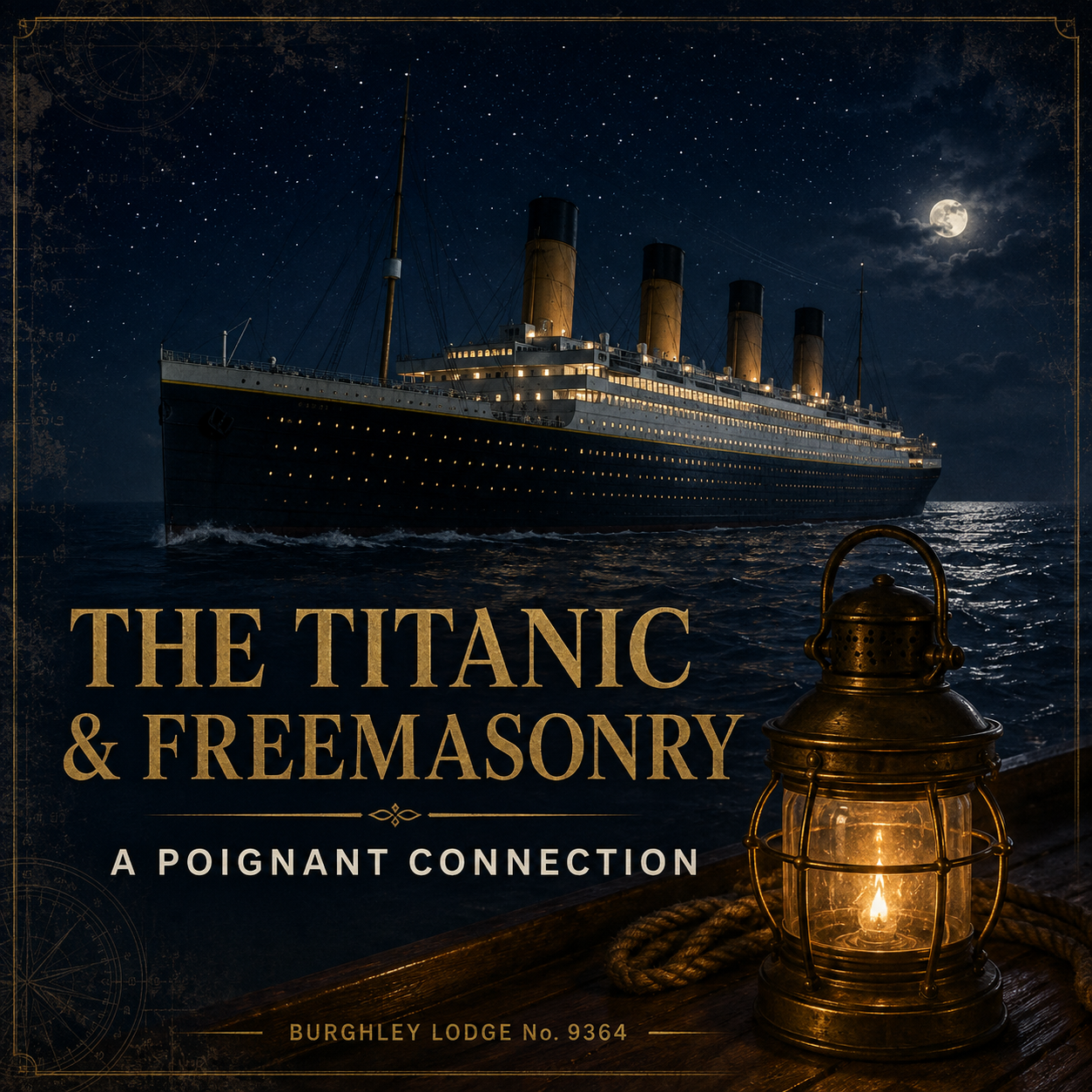
The Titanic and Freemasonry: A Poignant Connection
Few stories have captured the public imagination quite like that of RMS Titanic. When the White Star Line passenger ship struck an iceberg during her maiden voyage and sank in the early hours of 15 April 1912, more than 1,500 passengers and crew lost their lives.
Among those aboard were a number of Freemasons, each with his own personal story and connection to the Craft.
Freemasons aboard the Titanic
It is sometimes claimed online that the Titanic had its own Masonic lodge. However, there is no reliable evidence that a lodge was established or regularly met aboard the ship. The genuine connection is found in the individual Freemasons who travelled as passengers or served among her crew.
These men came from different backgrounds, professions and parts of society. Some were wealthy passengers, while others worked aboard the ship. They were members of different lodges, united by the shared principles of friendship, integrity, respect and service.
The story of Brother Henry Hill
One particularly moving story preserved by the Museum of Freemasonry is that of Brother Henry Hill.
Henry was initiated into Staines Lodge in Middlesex in March 1904. Originally a jeweller, he later suffered from tuberculosis and was advised to take a sea voyage in the hope that it might improve his health.
Unable to afford the cost of travelling as a passenger, Henry found employment with the White Star Line. After working as a steward aboard RMS Olympic, he joined the crew of the Titanic in April 1912.
Tragically, Henry did not survive the disaster. He left behind his wife, Florence, and their seven-year-old twin daughters, Eleanor and Florence.
Without Henry’s income, the family faced considerable financial hardship. His daughters were subsequently supported through the Royal Masonic Institution for Girls, which had been established to educate and care for the daughters of Freemasons whose families had fallen upon difficult times.
Their story offers a powerful example of Masonic charity continuing to support a Brother’s family after his death.
Brotherhood in the face of tragedy
The Masonic connection to the Titanic is not defined by one lodge or a single famous passenger. It is found in the individual lives of the Brethren who were aboard and in the families they left behind.
Their stories remind us that the history of Freemasonry is not simply a record of lodges, ceremonies and notable names. It is also a history of people, friendship and practical support during times of genuine need.
More than a century later, the loss of the Titanic continues to be remembered throughout the world. Within Freemasonry, we also remember the Brethren who shared that final voyage and the enduring bonds of compassion and charity that continued after the tragedy.
Burghley Lodge No. 9364 remembers all those who lost their lives aboard RMS Titanic on 15 April 1912.