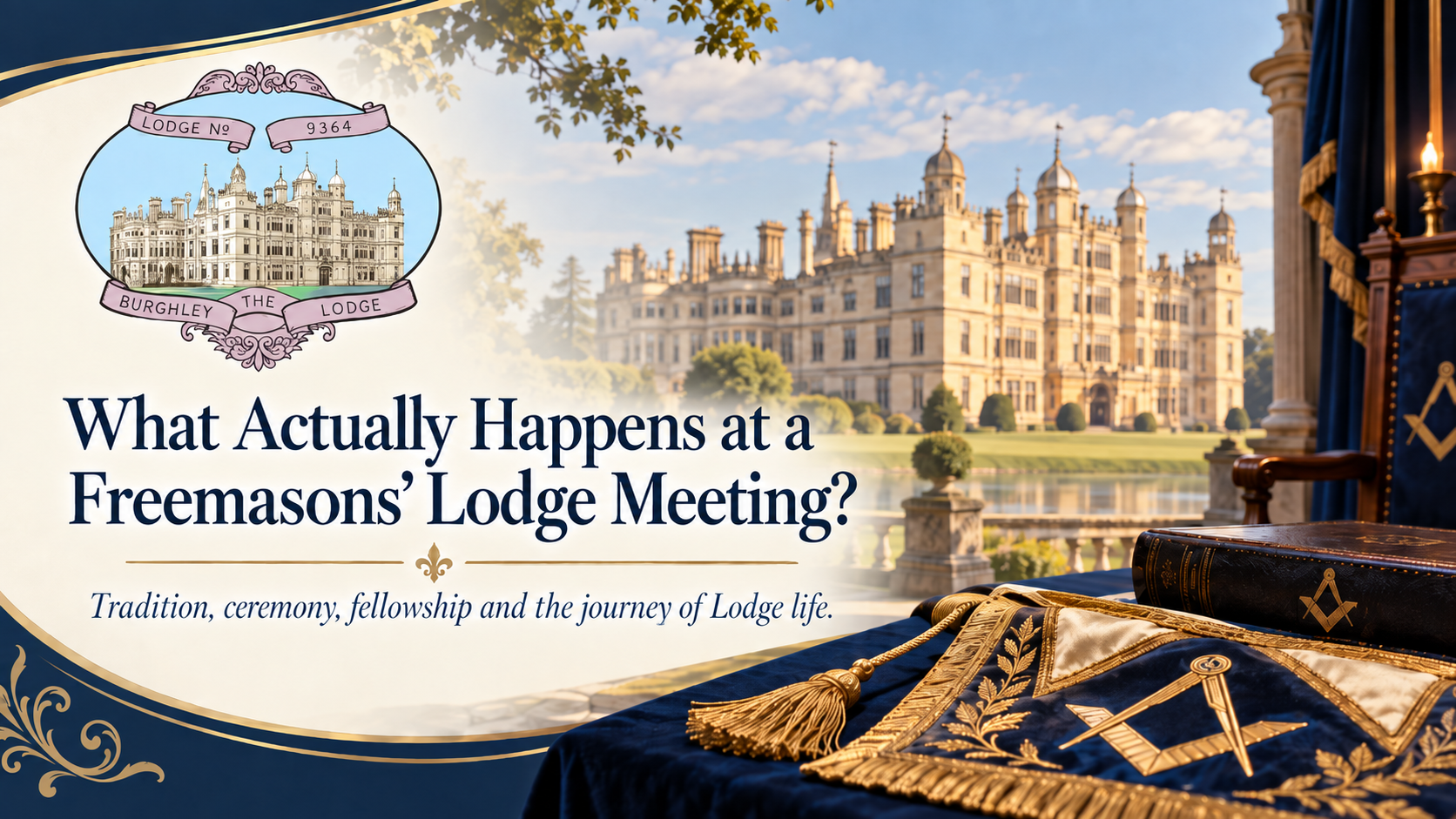
What Actually Happens at a Freemasons’ Lodge Meeting?
For someone who has never been inside a Masonic Lodge, the idea of attending a meeting can seem mysterious.
You may have seen photographs of ceremonial rooms, Masonic regalia or historic buildings and wondered what actually happens once the doors close.
The reality is often far less intimidating than people imagine.
A Lodge meeting is a mixture of tradition, ceremony, friendship, administration and social time. While certain parts of Masonic ceremonies remain private to members, there is plenty that can be explained openly.
At Burghley Lodge No. 9364 in Stamford, our meetings are about much more than ceremony. They are an opportunity for members to come together, enjoy each other’s company, continue their Masonic journey and spend an evening among friends.
It Starts With a Welcome
Before the formal meeting begins, members and visitors arrive, greet one another and catch up.
For many Freemasons, this is one of the most enjoyable parts of the evening.
You might see members from different age groups, professions and backgrounds talking together, welcoming visitors or introducing newer members to people they have not met before.
Although Freemasonry has formal traditions, the atmosphere around the Lodge is usually much more relaxed than outsiders might expect.
At Burghley, we want everyone who walks through the door to feel welcome.
Why Do Freemasons Wear Regalia?
One of the first things people notice about Freemasonry is the regalia.
Aprons, collars and jewels may appear unusual if you have never encountered them before, but they form part of the tradition and structure of the organisation.
Different pieces of regalia can indicate a member’s experience, office or responsibility within Freemasonry.
It is not about status in everyday life.
Inside the Lodge, a person’s profession, income or social position is far less important than their participation and character.
The regalia helps separate the Lodge environment from everyday life and reminds members that they are taking part in something with a long history.
The Formal Lodge Meeting
Once the Lodge formally opens, the evening follows an established structure.
Some meetings may involve administrative business, such as approving minutes, discussing charitable activity, welcoming visitors or dealing with matters relating to the Lodge.
Other meetings may include one of the ceremonies associated with a member’s progression through Freemasonry.
These ceremonies are an important part of the Masonic experience.
They use symbolism, traditional language and allegory to encourage reflection on values, behaviour and personal responsibility.
The purpose is not simply to learn words or perform a ceremony.
It is to encourage members to think about themselves, their relationships with others and the values they want to live by.
What Is Masonic Ceremony?
Masonic ceremonies are the traditional words, movements and symbolic actions that form part of Lodge meetings.
Much of this has been passed down through generations.
Members may learn sections of ceremonial work over time and take part in delivering ceremonies for newer members.
For some people, this becomes one of the most rewarding parts of Freemasonry.
Learning ceremonial work can help develop confidence, concentration, memory and public speaking.
Nobody is expected to arrive knowing any of it.
Everything is learned gradually, and members support one another along the way.
The Three Degrees
Craft Freemasonry is centred around three principal stages, known as degrees.
They are:
Entered Apprentice
Fellow Craft
Master Mason
Each represents a stage in a Freemason’s journey and introduces different ideas and lessons.
A new member progresses through these degrees over time.
There is no need to rush.
The experience is intended to be enjoyed and understood rather than treated as something simply to complete as quickly as possible.
What About the “Secrets”?
Freemasonry is much more open than many people realise.
Its values, charitable work, leadership, buildings and general activities are publicly available.
Members are free to say that they are Freemasons and to talk about their experiences.
There are, however, certain traditional aspects of ceremonies that members agree to keep private.
One reason for that is quite simple.
Experiencing a ceremony without knowing every detail beforehand allows a new member to experience it in the way generations before him have done.
It is perhaps better thought of as preserving the experience rather than hiding the organisation itself.
What Happens After the Meeting?
For many members, the formal meeting is only part of the evening.
Afterwards, members will often dine together at what is known as the Festive Board.
This is where much of the social side of Freemasonry comes to life.
Members and visitors sit together, enjoy a meal, share conversation and take part in traditional toasts.
There is usually plenty of laughter as well.
It is often during the Festive Board that friendships really develop.
A newer member who may initially know only a handful of people can soon find himself talking with members from other Lodges, different generations and completely different walks of life.
Visiting Other Lodges
One of the great traditions of Freemasonry is visiting.
Once a member has progressed sufficiently, there are opportunities to visit other Lodges and experience their meetings.
Although the structure is familiar, every Lodge has its own personality.
Some have particular traditions.
Others are known for their festive boards, ceremonies, history or social atmosphere.
Visiting is one of the best ways to understand the wider Masonic community and can lead to friendships well beyond your own Lodge.
Is It Very Formal?
Parts of a Lodge meeting are formal.
That is part of what makes the experience different from ordinary everyday life.
But formality should not be confused with unfriendliness.
Behind the ceremonial dress and traditions are ordinary people.
People who work, have families, tell jokes, make mistakes and enjoy spending time with their friends.
Many new members discover very quickly that Freemasonry is far less intimidating than they expected.
Do You Have to Speak in Front of Everyone?
Not immediately.
New members are not expected to arrive ready to perform long pieces of ceremonial work.
Participation develops naturally.
Some members quickly enjoy learning ceremonies and taking on responsibilities.
Others take more time.
Freemasonry gives people opportunities to build confidence gradually, supported by those around them.
For someone who has never been comfortable speaking publicly, standing in a Lodge and delivering even a short piece successfully can become a genuine personal achievement.
What Makes a Burghley Evening Special?
At Burghley Lodge, we want our meetings to combine the best elements of Freemasonry.
Tradition matters.
Ceremony matters.
But so do friendship, enjoyment and making people feel part of something.
A successful Lodge evening should leave members looking forward to the next one.
It should provide an opportunity to learn, to contribute, to catch up with friends and to welcome visitors.
It should feel meaningful without feeling inaccessible.
That is the balance we continually aim for.
You Cannot Fully Understand It Until You Experience It
You can read about Freemasonry.
You can watch videos.
You can explore websites and ask questions.
But there is an element of Freemasonry that is difficult to explain until you experience it yourself.
It is the atmosphere of walking into a Lodge where people know your name.
It is the friendship around the dining table afterwards.
It is the satisfaction of learning something you did not think you could do.
And it is the feeling of being part of a tradition that has brought people together for generations.
Curious About Freemasonry?
If you live or work in Stamford or the surrounding area and would like to know more about Freemasonry, you do not need to wait to be invited.
Get in touch with Burghley Lodge No. 9364 and start a conversation.
There is no pressure and no obligation.
You can simply ask the questions you have always wanted to ask.
Because behind the regalia, ceremonies and traditions, Freemasonry is ultimately about people.
Burghley Lodge No. 9364 — Stamford